Jianheng (Jaden) Hou
I work on agentic AI — and on the infrastructure, evaluation, and ML systems that take an idea from research to something that holds up in production.

I work on agentic AI — and on the infrastructure, evaluation, and ML systems that take an idea from research to something that holds up in production.
I've never found a clean line between being a researcher and being an engineer. The problems worth working on need both at once — the instinct to chase what matters, and the rigor to make it hold up in the real world. That overlap is where I do my best work.
I'm a Senior Machine Learning Engineer at Tesla. My work centers on agent systems — infrastructure, orchestration platform, harness, memory, apps, and benchmarks — along with enterprise ontology, multimodal recommendation, vision perception, and distributed systems. My current focus is building superintelligence (SI)–driven manufacturing and service solutions for Tesla's vehicles and Optimus. Along the way, I've been fortunate to be recognized as one of Tesla's Most Impactful People (2024) and as Top Talent in 2025 and 2026.
Interests & research focus
Outer ring, the lens. Inner ring, the craft.
My path runs through AI and manufacturing, media and telecom, and venture capital — most recently at Tesla, where I engineer enterprise AI and agentic systems from first principles, into products that ship under real constraints. At Comcast, I was in an enterprise ML/DS rotation, using data science and machine learning for 360° decision support across product, user growth, finance, and workforce. At Alpha Edison, I built an ML and quantitative decision engine for investing, to surface the silent pain points of consumers in vertical industries and move value through those industries by proactively backing high-potential startups. I take concrete problems and abstract them into research problems. At the University of Southern California's Information Sciences Institute, on the DARPA LORELEI THOR Project, that meant knowledge graphs, entity resolution, and online clustering, later applied in U.S. DoD settings, mentored by Pedro Szekely and Mayank Kejriwal. I hold an M.S. in Computer Science (Applied Data Science) from the Viterbi School of Engineering at the University of Southern California.
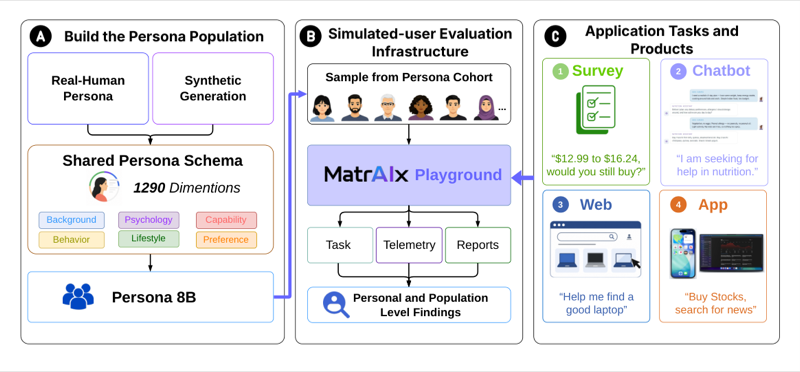
A population-scale, persona-driven infrastructure that instantiates 8.3B persona agents to evaluate AI systems and interactive products across surveys, chatbots, web, and apps.
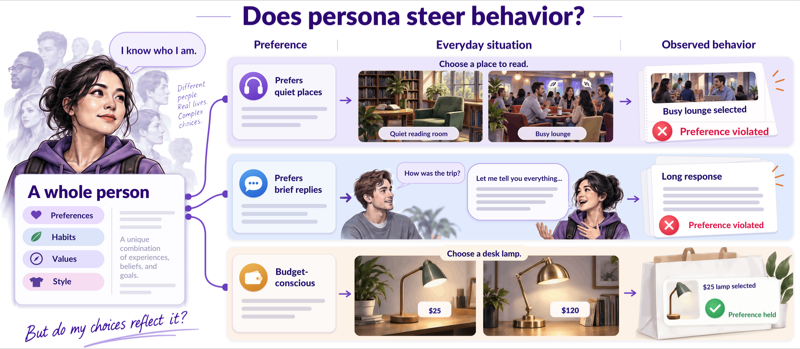
A benchmark for latent persona adherence — 2,460 tasks across survey, chat, web, and desktop app, scored from what the agent does, not what it says about itself.
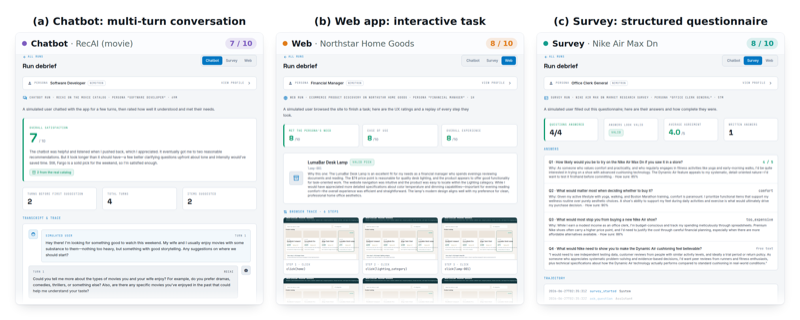
A plug-and-play persona-based user-simulation framework for repeatable, parallel evaluation of surveys, chatbots, and web applications.
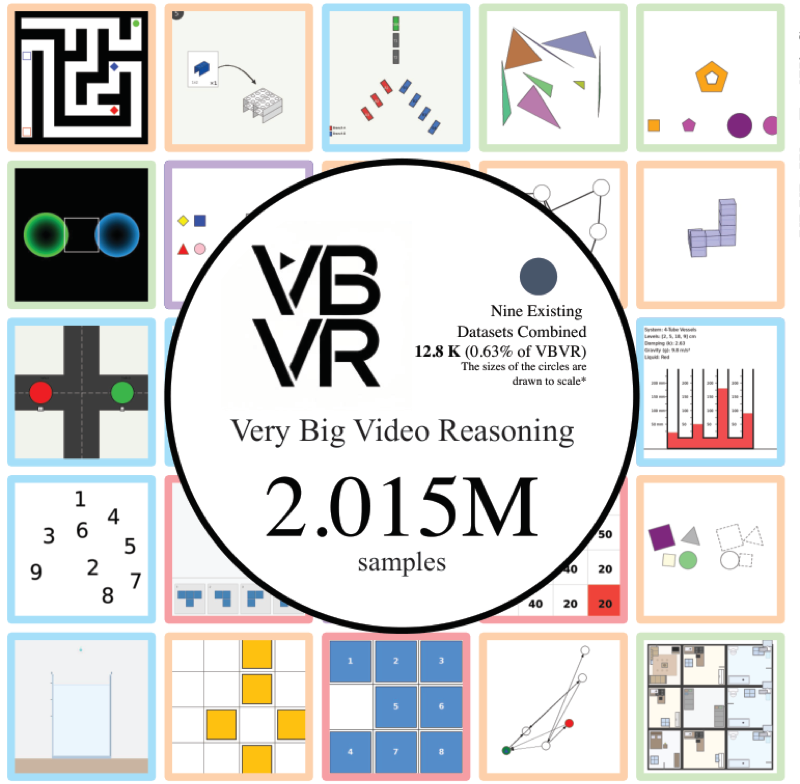
An unprecedentedly large-scale video-reasoning suite — 1M+ clips across 200 tasks with a verifiable, human-aligned benchmark — powering one of the first video-reasoning scaling studies.
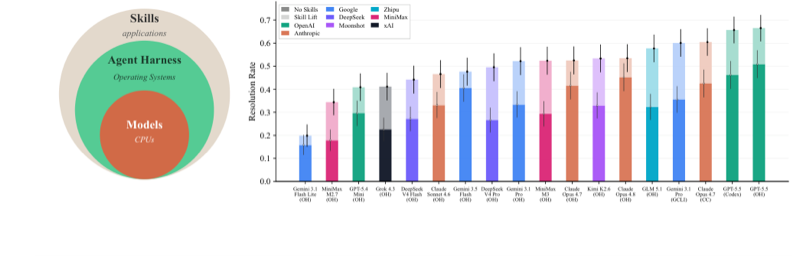
A paired benchmark that measures whether curated Agent Skills actually help LLM agents, using deterministic verifiers across 87 tasks and 8 domains.
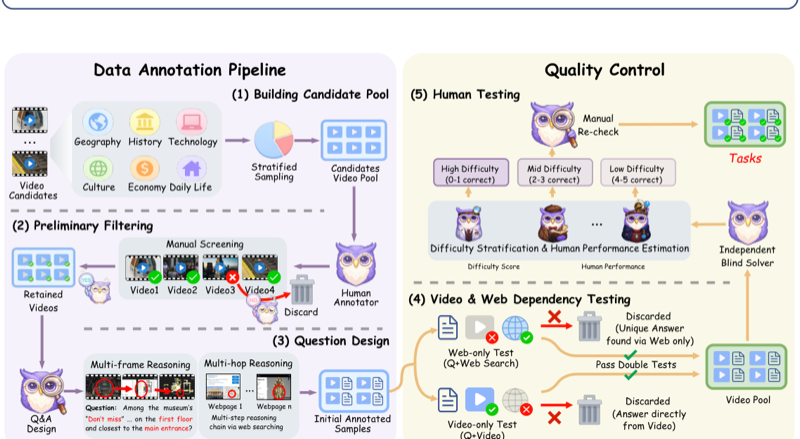
The first video deep-research benchmark requiring cross-frame anchor extraction, open-web retrieval, and multi-hop reasoning over joint video–web evidence.
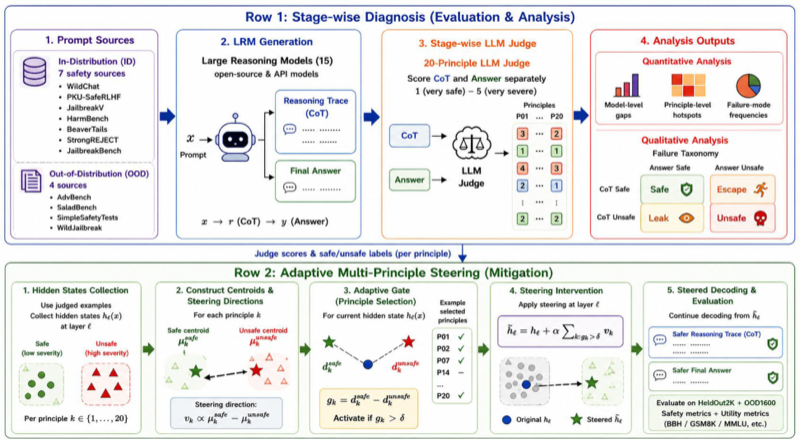
Diagnoses safety failures in large reasoning models and mitigates them with adaptive, multi-principle activation steering.
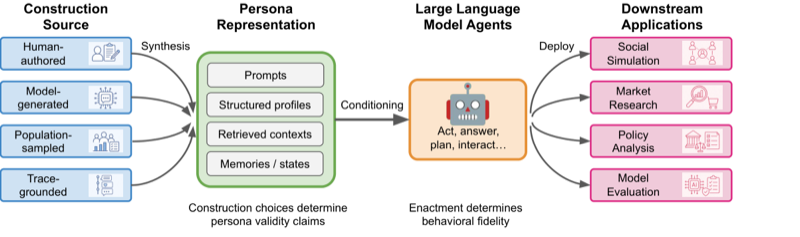
Argues that synthetic personas in LLM social simulation need explicit grounding, and proposes lightweight provenance and reporting standards.
Lead builder & core architect. I drove the end-to-end design and engineering of this population-scale, persona-driven infrastructure — from the 1,290-dimension persona schema and 1M-persona public coreset to the simulation runtime and evaluation pipeline.
Open tasks, harness, and leaderboard for whether a persona trait actually steers agent behavior across survey, chat, web, and desktop-app environments.
Contributor to the popular open-source platform for building agentic workflows and RAG pipelines, with rich AI model and tool support — moving teams from prototype to production.

A foundation agent for perception, reasoning, and action in the physical & spatial world — a modular, open-ended ecosystem of expert tools spanning 2D vision, 3D reconstruction, world modeling, and video/image generation.